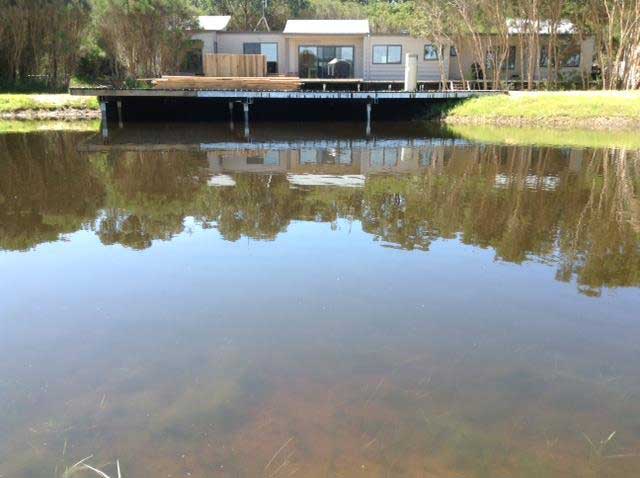
Docks and boathouses sit in ground that most foundation methods weren’t designed for. Saturated soil, fluctuating water levels, and a structure that needs to stay stable despite constant proximity to water all change what’s actually possible. Here’s what to consider before choosing a foundation method for a waterfront structure.
Why waterfront sites are a different problem
Traditional bored pier construction relies on an open excavation staying open long enough to place reinforcement and pour concrete. Near water, that’s a much harder condition to manage. Saturated ground and high groundwater can cause a bore to collapse before concrete goes in, sometimes requiring casing or dewatering just to get the hole to hold its shape, adding cost and time to a job that’s already working around water levels and, often, tidal movement.
Screw piles are installed by displacing the ground rather than excavating it, which removes the open-bore problem entirely. Installation remains stable in waterlogged and saturated conditions where a bored pier would be impractical.
What actually needs to be considered
Corrosion protection. This is the single most important consideration for any steel foundation near water. Soil aggressiveness, groundwater chemistry, and, for coastal or brackish sites, salt exposure all affect the corrosion allowance a pile needs. This is typically addressed through sacrificial steel thickness, galvanising, or protective coatings, specified to the site’s actual conditions and the structure’s required design life, not assumed generically.
Fluctuating water levels. A dock or boathouse foundation needs to perform through both submerged and exposed conditions, and design has to account for the soil behaviour across that range, not just at a single water level measured on the day of investigation.
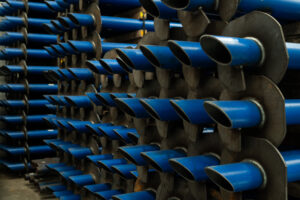
Uplift and lateral loads. Waterfront structures, particularly boathouses and any structure with a roof or walls near open water, can be exposed to significant wind loading and, in some settings, wave or current action. Screw piles perform well in resisting uplift specifically because the helix plate engages the surrounding soil in both directions, but the design still needs a structural engineer to check these loads against the site’s specific conditions.
Minimal disturbance to the waterway and surrounding environment. Because no excavation or spoil is generated, screw pile installation avoids disturbing sediment, nearby vegetation, or adjoining structures, which matters on sites that are often environmentally sensitive by nature.
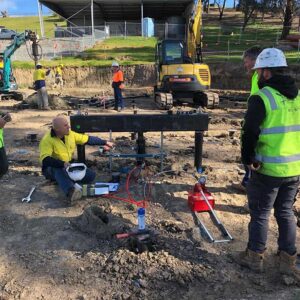
Access. Waterfront and riverbank sites are frequently difficult to get standard plant into. Screw pile rigs can be considerably smaller than drilling rigs, which is often the deciding factor on sites where a barge, a narrow bank, or a jetty is the only way in.
Where the limits are
Where rock occurs at shallow depth, as it does on some riverbank and coastal sites, a bored pier may be the more reliable option, and pre-drilling or a site-specific assessment may be needed. As with any application, the right answer depends on a geotechnical investigation of the specific site, not a general rule for “waterfront.”
The point
A dock or boathouse foundation has to deal with conditions most residential foundations never face: saturated ground, fluctuating water levels, and often difficult access. The right foundation choice comes down to a site-specific assessment of ground conditions, corrosion risk, and structural loads, the same engineering process as any other site, just applied to a more demanding set of conditions.