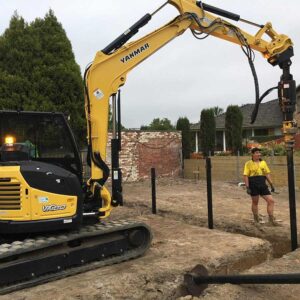

A sloping block, a soft or saturated site, or a block with restricted access shouldn’t mean compromising on the build. But it often changes what’s possible with a standard foundation approach, and it’s worth understanding why before a design gets locked in around the wrong assumption.
Why difficult sites cause problems for standard foundations
Traditional bored pier construction relies on an open excavation staying open long enough to place reinforcement and pour concrete. On a sloping site, that’s harder to manage safely. In soft sands or saturated ground, the bore can collapse before the concrete goes in, sometimes requiring additional shoring or casing just to get the hole to hold its shape. Restricted access adds another layer of difficulty: drilling rigs and concrete trucks need room to manoeuvre, and not every site has it.
None of this means the site is unbuildable. It means the standard method needs to adapt, or a different method needs to take its place.
How screw piles change what’s possible
Screw piles are installed by displacing the ground rather than excavating it, using a hydraulic drive head that turns the pile into place under controlled torque. That has a few practical effects on a difficult site:
No open excavation.
Because there’s no borehole to keep open, ground conditions that would collapse a traditional pier, such as soft sand, waterlogged soil, or unstable fill, aren’t the same obstacle for screw piles.
Smaller equipment.
Screw pile rigs can be considerably smaller than drilling rigs, which matters on a sloping block, a tight urban site, or anywhere plant access is genuinely limited.
No spoil to remove.
Since the ground is displaced rather than dug out, there’s little to no spoil generated, which avoids the cost and disruption of hauling material off-site that may already be hard to access.
Design that follows the ground, not the other way round.
Pile depth, spacing, and configuration can be adjusted to suit the specific site, rather than forcing a uniform method across variable conditions.
Where the limits are
Screw piles aren’t the answer to every difficult site. Where shallow rock is present, a bored pier is generally the more reliable option, and pre-drilling or a site-specific assessment may be needed before screw piles are viable. And on any site with genuinely difficult ground, whether that’s reactive clay, collapsing soils, or a steep slope, the right answer comes from a site-specific geotechnical assessment and engineering design, not a generic rule of thumb.
The point
A difficult site doesn’t have to mean a difficult build. It means the foundation method needs to be chosen based on what the site actually presents, rather than on habit. That’s a site-specific engineering conversation, not a product decision made in advance.