
Three years into FTA’s Foundation Partnership with prefabAUS, modular work now represents over 50% of the company’s revenue. Steve Hassett explains what’s driving the shift—and where the next frontier lies.
SBR: Modular construction is all about speed and precision. How do helical screw piles fit into that factory-built mindset?
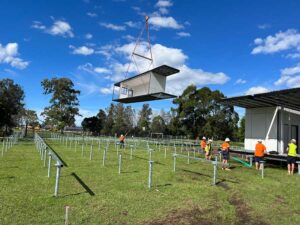
Steve Hassett: It’s a matter of technical synergy. Modular buildings are engineered to tight tolerances in a factory. With traditional bored piers, you’re dealing with wet trades—drilling, pouring concrete, waiting for it to cure. Helical piles are essentially giant steel screws. We drive them into the ground using hydraulic torque, and the moment they reach the required depth, they’re ready for load. No curing time. The building can arrive on a truck the very same afternoon the foundations are finished.
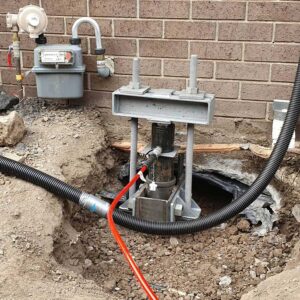
There’s also engineering certainty. We monitor installation torque and have a direct mathematical relationship between it and load-bearing capacity. With a bored pier, you’re making an educated guess based on a soil report. With a helical pile, every single pile is essentially its own load test.
SBR: You’ve partnered with UK-based RADIX to bring friction-based ground screw technology to Australia. What does that add to your toolkit?
SH: A friction pile works on a different principle from a helical pile. It starts out slender and widens in diameter as it’s installed, compressing the soil outward—like a screw going into timber. Where it really comes into its own is in harder soil profiles. A helical pile may struggle to cut through very hard clay because of its helix plate diameter. A ground screw, with its thin tip, can reach deeper—making it better suited to the highly reactive hard clay soils we encounter across much of Australia.
We’re also working with RADIX on foundation solutions for the renewable energy sector—battery storage and solar infrastructure—where the combination of helical piles and ground screws gives developers options matched to specific site conditions.
SBR: Three years into the prefabAUS Foundation Partnership—how has that shaped FTA’s business?
SH: It’s been mutually beneficial. prefabAUS has given us the opportunity to understand the key drivers for the modular and prefab industry, which has helped us shape our offer—from connection details to understanding the benefits in remote and regional Australia. The relationship lets us network directly with key modular builders to get our market offer right.
The numbers speak for themselves. Modular has grown from about 15% of our revenue five years ago to over 50% today. We’re delivering roughly 500 modular builds a year—retirement villages, school buildings, workers’ camps, and everything in between.
SBR: Your Glen Waverley project involved convincing sceptical engineers. Is that still a barrier?
SH: Absolutely. Just last week, a builder wanted to convert a job to screw piles, and his engineer said, “screw piles don’t work.” Another told me he “didn’t trust this new technology.” I said, “Mate, it was invented in 1833—we’re not that new.”
It is improving. Once our engineer, Travis, speaks to them, they convert fairly quickly. But the real game-changer is early engagement. Builders who are motivated—and this is where the prefabAUS network is key—are coming to us before the engineer’s finished and asking, “Is this a screw pile job?” We then collaborate with the design engineer from the outset. We’ve done that really successfully at a mining camp in Cloncurry, where early engagement saved the client significant time and money.
SBR: What’s next for FTA?
SH: Vertical integration—that critical connection point where the screw pile finishes and the building starts. We’re working with modular manufacturers and bracket suppliers to perfect how our piles connect to their chassis systems. It sounds like a tiny detail, but it affects crane tolerances, build timelines, and cost.
Once we’ve nailed that, I see a whole lot of new opportunities. We’ve got the screw pile expertise, the modular industry knows their building—it’s about joining the two together for truly seamless Smart Building delivery.
This article was originally published in Smart Building Review Australia, the official publication of prefabAUS, Australia’s peak industry body for prefabrication and Smart Building.