A screw pile isn’t a single, fixed product that gets specified once and installed everywhere. The shaft, the helix configuration, and the steel thickness are all selected to suit the ground a specific pile is going into, and getting that wrong has real consequences for capacity and durability. Here’s what actually drives those design decisions.
Why the ground comes first
Before any pile is designed, a geotechnical investigation establishes the soil profile, founding conditions, groundwater, and any reactive clay behaviour present at the site. Without this site-specific data, a screw pile design generally can’t be certified as compliant with the National Construction Code. Everything that follows, helix configuration, blade thickness, shaft type, depth, is a response to what that investigation finds, not a standard spec applied regardless of ground.
Bearing plate (helix) configuration
The helix, or bearing plate, is what a helical pile uses to develop capacity, working through a combination of end bearing at the plate and skin friction along the shaft. How many helices a pile has, their diameter, and their spacing are all selected based on the soil’s strength and layering. Weaker or more variable soils generally need a different helix configuration to firm, uniform ground, since the design has to achieve reliable bearing at whatever depth the competent soil actually starts.
This is also why helix diameter matters in harder ground. A wider helix plate can struggle to cut through very hard or highly reactive clay, which is one of the reasons FTA also uses ground screw systems, a different pile type that develops capacity almost entirely through skin friction along a tapered shaft rather than end bearing at a helix, and can reach useful depth in soils where a helical pile’s plate geometry becomes a limitation.
Blade thickness and shaft selection
Blade (helix) thickness and shaft dimensions are chosen based on the installation torque and structural loads the pile needs to withstand without buckling or deforming during installation. Ground with higher resistance, denser soils, gravels, or partially weathered material, generally demands a heavier-duty blade and shaft than soft, uniform clay. Getting this wrong in either direction matters: undersized components can be damaged during installation in hard ground, while oversized components add unnecessary cost in soil that doesn’t need it.
The role of K Value
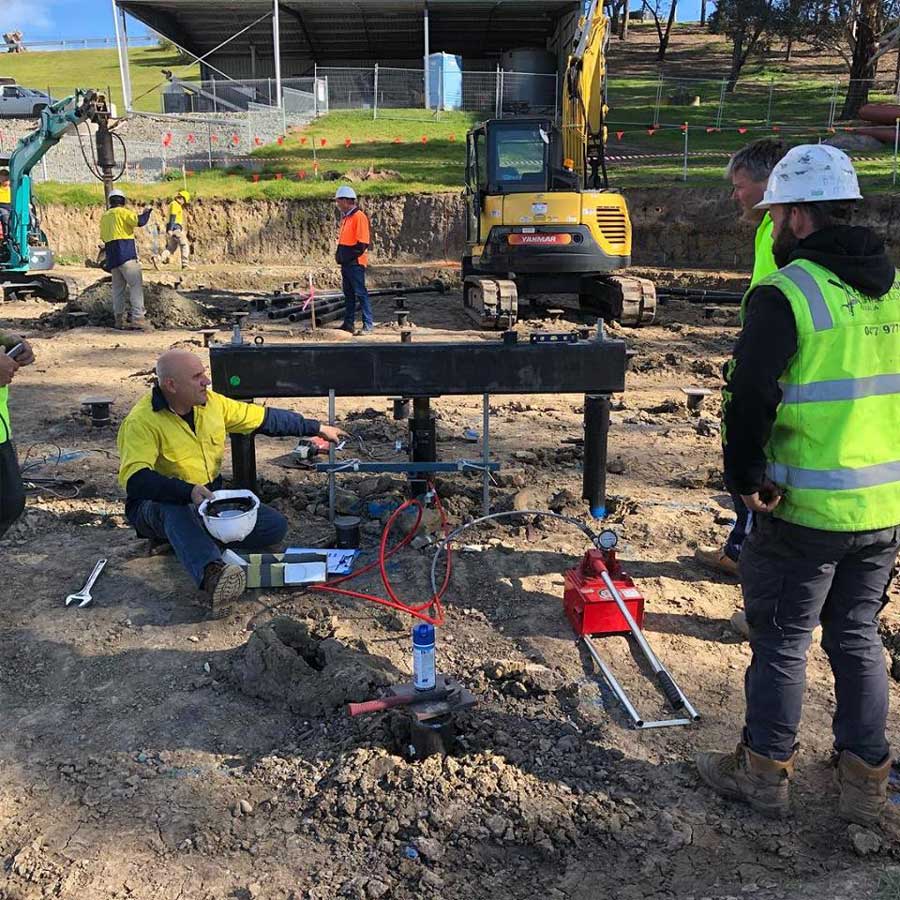
Every screw pile system has a K Value, the factor that correlates installation torque to load capacity (expressed as Q = K × T). This value is established through load testing and engineering validation, and it’s specific to each pile system’s geometry, shaft dimensions, and material properties, it isn’t interchangeable between different products. Once validated for a given system and soil type, K Value is what allows torque, measured in real time during installation, to double as verification that the installed pile has actually achieved its design capacity.
Corrosion and durability
Soil aggressiveness, groundwater chemistry, and stray current risk all factor into the steel specification for a given site, through sacrificial steel thickness, galvanising, or protective coatings, calibrated to the required design life (typically 50 years for residential work, 100 or more for infrastructure).
The point
There’s no universal screw pile. Helix configuration, blade thickness, shaft type, and corrosion allowance are all outputs of the site’s specific ground conditions, verified against a validated K Value during installation, not settled on a spec sheet in advance. That’s the difference between a foundation designed for a site and one assumed to work because it worked somewhere else.